
Quick-Quote Quills and odd Cupid/Psyche allusions:
Myth-retelling or signpost reminders?

Greetings from sunny-if-chilly Auburn, Alabama, where I have had the privilege of spending the weekend with my extended family celebrating my nephew’s university graduation. I had a little time to start putting some Cupid and Psyche thoughts together, so I will at least try to get this long-planned post started, though finishing it may have to wait until I am home in Virginia.
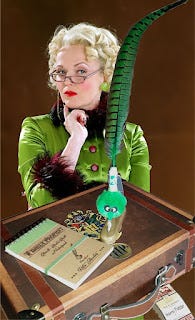
Minor note: I have learned that a Quick-Quotes Quill -wielding website has misrepresented my overall take on The Hallmarked Man, claiming I characterized it as “a real stinker” and “the worst book ever.” After over three decades as a PhD student, post-doc and tenured university professor, I have learned to be more amused that irritated when this sort of thing happens. Even the best readers get careless sometimes, so focused on inventing a straw-man antithesis to their own position that they gloss over helpfully highlighted summaries, such as that which appeared in the final post of my Real-Time Re-read.

I will admit, however, to being a bit perplexed as to why someone would believe me so foolish as to spend eight months writing over 70 lengthy blog posts about a novel which I found so utterly without merit.
Ah, well. Uva uvam vivendo varia fit. On to Cupid and Psyche!
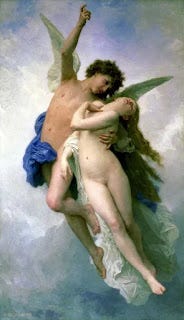
In light of the Cupid and Psyche painting teaser that Galbraith tweeted last year and the head of Persephone charm on the hint charm bracelet, many readers are hoping to see an end to Robin’s trials and a union with Strike, if not in Sleep Tight Evangeline, at least by the end of the series. Certainly Robin has had more than her fair share of suffering over the last two books, between the trauma of Chapman Farm and the multiple losses she faced in The Hallmarked Man, from her fertility to her Land Rover to her trust in Strike. Not to mention the near-constant stress-fest that her relationship with RFM has become.
Those familiar with the myth of Cupid and Psyche know that the jealous Aphrodite assigned four tasks to Psyche:
Sorting a massive pile of mixed grains (which she completed with the help of some generous ants)
Collecting golden fleece from some particularly dangerous sheep (a helpful reed advised her to just pull it off the bushes after the sheep lay down to rest)
Collect water from the inaccessible waterfall that feeds the River Styx (Zeus’s eagle kindly flew up the mountain and filled the cup for her)
Retrieve a box of Persephone’s beauty cream and take it to Aphrodite (After following a tower’s instructions to pay Charon for passage, feed cake to Cerberus and avoid speaking to any dead people she met, Psyche was overcome by curiosity on the way back and opened the box, falling into a deep sleep, from which she had to be rescued by Cupid).
So, can we point to distinct trials of Robin’s that correspond with these four tasks, in the same way as, for instance, we saw direct links with the Francis Rattenbury murder in Lethal White, or between the lives of Nannie Doss and Janice Beatty in Troubled Blood? Like other serious Strikers interested in mythological links way before the tweeted teasers, I have been looking for such linkages for several books now, but, post-THM, I am thinking that we probably won’t see anything that overt. Instead, I think we are seeing occasional “pointers” to remind us of the myth without direct parallels in the narrative. Eros and Cupid have come up in the earliest books; for example, the “Eros” statue where Matthew proposed and the snowy Cupid at the Chelsea Arts Club in The Silkworm.
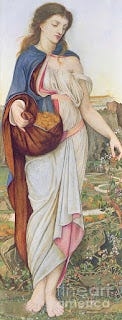
The most obvious pointer to Psyche’s trials in The Hallmarked Man was the Golden Fleece pub, where Strike was asked to meet Rena Liddell but instead wound up with Ralph Lawrence. Of the hundreds of popular pub names Galbraith could have selected, he chose one with a direct connection to Psyche’s second trial. The weird part is, Robin, our putative Psyche, had absolutely nothing to do with this part of the mystery. Rena communicated only with Strike; Robin neither saw or spoke to her and certainly never visited the pub. The name stands out like a signpost to tell us the trials of Psyche are part of this story, but the Golden Fleece pub itself is not directly relevant to any of Robin’s ordeals. We’ve been told before of Robin’s sheep expertise; those nasty beasts of Sir Anthony’s whose breed she recognized sound a lot like the critters Psyche faced. We were also reminded that sheep are among the private jokes that Strike has with Robin and commemorated on the silver charm bracelet. Thus, it seems odd to have the Golden Fleece clue so completely unconnected to our favorite farm girl.
Another character from the myth that shows up is Cerberus. Plug’s prize fighting dog is described as a “dog that looked to Robin the kind of creature that might guard the gates of hell;” Hagrid would probably have named it “Fluffy.” Robin manages to subdue a different but equally savage pooch named “Lennon” as it attacked Strike, though with pepper spray, not barley cakes.
As for the grain-sorting task, the closest I saw in THM was the great connection pointed out on The Strike and Ellacott files, with the reference to the moment our heroes “isolated the puzzle pieces of William Wright from those of other men and assembled them correctly.” No thanks to any ants, however; not even Rupert’s Aunt Anjelica, who was decidedly unhelpful. I guess Rupert’s ex-aunt-by-marriage, Tara, unwillingly offered some help in solving the puzzle, but again, Strike, not Robin, was the one that dealt with her.
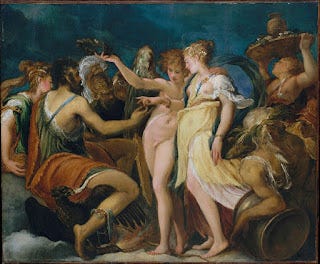
Rivers associated with death abound in THM, with three people (Ben Liddell, Niall Semple and the unnamed rapist crony of Griffiths) dying by plummeting from a bridge into a river. But, yet again, the deadly rivers appear primarily in Strike’s part of the novel and have little to do with Robin. As for the eagle, the only ones that appear are the two-headed eagle on the Masonic medals, and the “eagle” hidden in Sapphire Neagle’s name, neither of which has connections to the myth that I can discern. Instead, I found myself thinking of the divine owner of Psyche’s feathered helper, Zeus. In mythological analyses of the series, the counterpart of Zeus is generally considered to be Jonny Rokeby, impregnator of Leda*. In the myth, Cupid, after rescuing Psyche, flies off to Zeus to beg for help; Zeus steps in, tells Aphrodite to back off and brings Psyche to Olympus for an ambrosia meal that will elevate her to goddess status and allow the union to Cupid to be restored. Strike does indeed have to seek Rokeby’s help in The Hallmarked Man, although it is not specifically Robin who is in jeopardy, but Strike’s reputation and his agency. Still, it is interesting that Rokeby, like Charlotte, seems to have learned quite a bit about Robin as he follows Strike’s detective career. Remember how, when he calls the office to offer his help after the Candy story, he asks to speak to her if Strike won’t talk to him?** Perhaps the best piece of advice he gave Strike in Chapter 105 was “Don’t let Robin go, if that’s what you want;” it’s advice Strike wound up following when he wrenched open that office door.
The only other part of THM I can see that might be an allusion to the Cupid and Psyche myth were the moments where Robin was nearly persuaded that Strike could be a monster, somewhat like Psyche’s jealous sisters convinced Psyche that her never-seen husband must be a hideous creature. The first was when Robin learned from Ilsa about the possibility that Strike had fathered Bijou’s baby, which leads her to cancel the trip to Scotland and ultimately winds up in their massive “weak link” row in Ironbridge. The second incident-- Valentine Longcaster planting the idea that Strike might have been a domestic abuser--is probably more appropriate as an echo of Psyche’s sisters. Ilsa, after all, is kind, friendly and truthful; Valentine is nasty, bitter and spreading lies, and few would object if he threw himself off a cliff the way Psyche’s sisters did. But, as far as we know, Strike never learned of Robin’s suspicions and the role they might have played in the anger that exploded at the Swan Taphouse. And he certainly didn’t choose to leave her for her lack of trust; if anything, she fled from him.
Given the Persephone head charm in the STE hints bracelet, we can expect that Robin’s trials are not yet over. It is possible the narrative will be a little more relevant to the myth in the next book. Personally, I would love it if Robin had to interview a make-up artist or beautician, as Strike did in Books 1 and 4. We could also get a situation where Robin winds up injured or unconscious (possibly due to something she had been told not to do) and Strike has to come to her rescue. That would be an interesting contrast to the way Robin rescued both herself and Strike in THM. What would be especially interesting is if Rokeby revises his Zeus role, and is somehow helpful in bringing Strike and Robin together.
All for now! Comments welcome! Having trouble commenting or subscribing? Try the all-for-free content on the Substack version of this blog.
*We were reminded of the myth of Leda and the Swan both in the mural at the Ritz and in Paul Satchwell’s artwork.
** Rokeby appears more respectful of Robin’s status as agency partner than is KFC.
A bunch of us have been noticing the number to times Strike has a Psyche-like reference - and wonder if she’s playing with the myth both ways - so Strike as the Psyche to Robin’s Cupid, just as much as she is the Psyche to his? Both holding up the light and the knife illuminating the true nature of each other.
Alabama and Virginia, eh? Was born in Tennessee myself, and most of my family are originally from West Virginia, though we've lived in Ohio for decades.
Excellent take on things that may appear in the next novel.